
Where is Meaning?
In my last post, I explored the idea that AI models may be converging on the same underlying map of meaning. It seems that meanings don’t so much reside in the words themselves but in how they relate to other words. Once I put it that way, it seems obvious. “Of course, words don’t have any intrinsic meaning in isolation, it is only their relationship with other words that they take on meaning.”
So, perhaps meaning resides in the relationships.
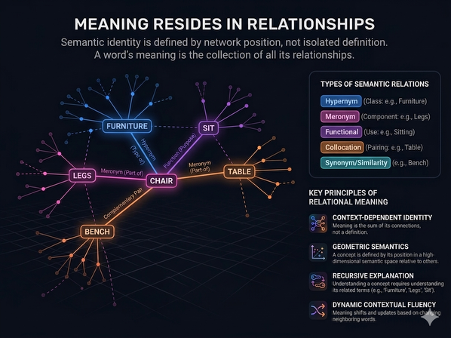
It seems that our large capacity brains allow us to map these relationships and make use of them to show intelligent behavior. This fact has formed how we approach making LLMs more intelligent: increase their size. If you want more reasoning, more abstraction, more generality, you scale up the model. More parameters. More data. More compute. The story of progress has largely been the story of making a single monolithic system larger and more capable.
And clearly, this works.
Other Paths
In nature, there are examples that take a different approach and still exhibit complex, intelligent behavior. Ant colonies, bee swarms, immune systems, all produce complex behavior, but the ‘model’ is not held in a single unit but is spread across thousands of units.
Biological systems suggest a few recurring ingredients.
1. Simple local decision process. Individual agents operate with limited number of states and actions and simple rules.
2. Communication Agent exchange signals that help to coordinate behavior.
3. Feedback loop. Successful patterns are reinforce over time and unsuccessful ones are undermined.
4. Shared Memory. Information can persist outside any single individual.
5. Critical mass. Some behavior seem to appear only when enough interaction units participate.
In other words, perhaps some of what we call intelligence does not come only from scale within a model, but also from structure between models.
A Modular Approach
Can we take a similar approach towards artificial intelligence?
This question matters because monolithic scale has costs. Giant models are expensive to train, expensive to run, difficult to update, and hard to interpret. If a capability is buried inside one huge parameter space, improving one part often means retraining or rebalancing the whole.
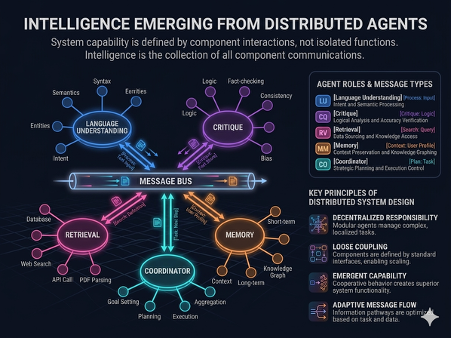
A modular system offers a different possibility. One model could specialize in language understanding. Another in retrieval. Another in critique. Another in planning. Instead of collapsing everything into one giant network, they could coordinate through a shared communication framework.
Of course, a collection of smaller systems does not automatically become intelligent just because they can exchange messages. However, this does shift the conversation. The question is no longer, “How much bigger does a model have to be to display behavior xyz?” A more general question is, “What are the conditions necessary for xyz to emerge?”
Because if intelligence can emerge from interaction rather than just accumulation, then the future of AI may not belong only to the largest models. It may belong to systems that are loosely coupled, specialized, and able to discover how to work together.
Comments
Post a Comment