
Are All AI Models Secretly Speaking the Same Language?
As I’ve been digging into how generative AI actually works under the hood, I ran into something that took me a while to wrap my head around.
LLMs turn words and phrases into something called embeddings — basically points in a high-dimensional space called “latent space”. Once everything is mapped into this space, the model can measure how similar things are using something called cosine similarity.
The closer two embeddings are, the more related they are. As you would expect, ‘dogs’ and ‘cats’ end up close together but so do more complex relationships such as “doctor” and “hospital” where the model capture not only physical similarities but also functional similarities.
So far, that makes sense.
But then I came across something that completely changed how I think about this space. You can subtract and add concepts together. For example, if you take the embedding for “king”, subtract the embedding for “man”, and then add “woman”, you end up with “queen.”
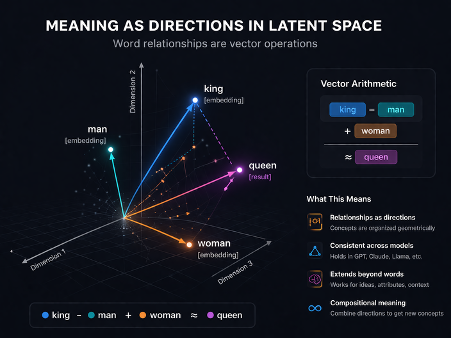
The multi-dimensional coordinates of these words have a certain structure, where gender or royalty are directions in space that can be traversed. There are vectors that capture hierarchies (animal-mammal-dog), concreteness (abstract-concrete), sentiment (good-bad), and formality (casual-academic).
Modern models use thousands of dimensions. Some dimension may capture some essence like royalty and gender, but thousands of dimensions doesn’t translate to just thousands of concepts; these dimensions combine to allow the model to represent many millions of semantic concepts, abstract ideas, tone and intent, subtle context.
And here’s where it starts to get a little mind-bending.
These relationships are not model-specific, they hold across the different models and architectures. Models trained using different data, different languages, with different architectures, all mirror each other in the way the latent space is structured, they share a geometry. It seems like they are all capturing the same underlying map of meaning.
And it doesn’t stop with AI. Some studies suggest that human brains may organize language in a similar way:
· Neural activity in language regions forms patterns similar to embeddings
· Larger models begin to resemble how our brain processes language.
· They’re not saying they’re identical — but the overlap seems to be pointing at something deep.
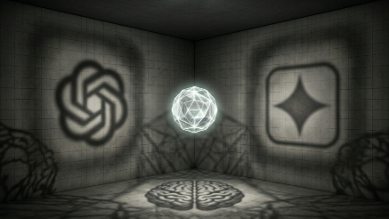
This starts to look a lot like Plato’s allegory of the cave. In the allegory, people are stuck in a cave watching shadows projected onto a wall. They think the shadows are reality, but they are only projections of something deeper and more real. Only by somehow transcending the cave can you see what has been creating these shadows.
What if each of the model’s latent space, and even our own mental representations, are like those shadows, and some universal latent space exist?
Comments
Post a Comment